Giants and the Foundations of Greater Intelligence
In the remote past, giants were worshipped as gods. Indeed, most of all the gods and goddesses of antiquity were of gigantic stature. In ancient Norse mythology, the first being ever to have lived was Ymir, the frost giant, from whom everything else was created. From his bloodline descended the first race of giants and gods, and ultimately it was from his murdered and dismembered body that the world and mankind were formed.
This also brings forth a discussion regarding the origin and usage of the name God, the roots of which can be traced back to the Old Germanic word Got. Prior to the introduction of this particular title, there existed the Latin deus and the Greek theos. In ancient times, even in the Hebrew tradition, it was widely known that these words, those signifying a power greater that oneself, applied not to a single omnipotent being but rather to “beings from the sky”, always denoted in the plural.
In the annals and chronicles of ancient times, both gods and giants have been categorised as “advanced beings” or “sky gods”. The question remaining is: what difference, if any, exists between gods and giants? Who, then, were the giants described in ancient times? Are they mere fantasy or do they represent a tangible link to our prehistoric ancestors?
Technologies of the Gods Revisited
The underlying truth of this omnipresent mythos of giants goes beyond mere ancient record-keeping, however. In order to establish that the giants of antiquity were not the product of the primitive imagination, it is necessary first to establish as face the feats and wisdom of the ancients. This inevitably leads to a discussion of their pre-modern technological achievements, some far in advance than even our own today. What we have found is that the civilisations of the ancient world were far more advanced than many archaeologists are prepared to admit.
Let us assume for the moment that the ancient traditions of the gods imparting knowledge and wisdom to the early human race are not mere fantasy but are based on eyewitness accounts of actual events. This was not a mis interpreted record of an ancient alien visitation, but a direct account of an early race of giants passing on what it had learned from the gods to mankind in a form of succession, passing the torch to yet another generation of antient Terrans, or Earth-born beings.
The Ancient Chinese
The Chinese armies were employing poisoned gas over 2,500 years before it was invented and used by the West during World War I. The Chinese were developing cast iron in the fourth century BC, over 1,700 years before it was fist used by Europeans, and were creating steel from cast iron in the second century BS, over 2,000 years before westerners first learned to manufacture it.
In addition to inventing flying craft and military technology, the Chinese developed practical innovations for mass consumption – including, as rumored, the first earthquake-resistant houses. Around 735 CE, two Chinese inventors were credited with developing the first mechanical clock. In addition, the Chinese had been employing gunpowder since the ninth century or earlier. They used it for fireworks as a means to frighten opposing armies or to announce the coming of an invading force, rather than as a weapon. An individual named Bi Sheng introduced movable type in 1045 CE, over four centuries before the printing of the first Gutenberg Bible.
According to David Hatcher Childress, author of Technologies of the Gods: “The Chinese have always had great scope and vision regarding their projects; not only was the Great Wall a colossal endeavor, but the Grand Canal of China, which connects the Yellow River with the Yangtze, is twenty times longer than the Panama Canal – yet the Chinese constructed it without modern equipment starting over 1,300 years ago! There are other mammoth projects that are still unknown or waiting to be discovered, such as the largest pyramid in the world, near Xian. Even the Chinese version of the typewriter, called the Hoang typewriter, has 5,700 characters on a keyboard two feet wide and seventeen inches high!” (Childress, 2000, p. 23)
That Chinese civilisation may have been jump-started by an extramundane source, during the time when the primaeval giants passed the knowledge of what they had learned to the chosen people of the new era, is not surprising.
Joseph Needham of Cambridge University wrote with regard to the splendour of early Chinese inventions: “First, why should they have been so far in advance of other civilizations; and second, why aren’t they now centuries ahead of the rest of the world?” (Quoted in Childress, 2000, p. 24)
Childress concludes that perhaps China inherited its knowledge from an older civilisation. “Its discoveries, like ours, are just the rediscovery of ancient technology from the roller-coaster ride of history.” (Childress, 2000, p. 24)
Based on these few examples alone, it is clear that our ancestors did in fact possess the same intelligence, logic and rationality as more modern “advanced” cultures, which in my opinion makes it highly probable that there is some truth behind these legends.
Remembering Through World Mythology
As with all mythological accounts, however, these are but blurred images of a far more profound reality. Indeed, these gigantic inhabitants of our imagination are not mere figments but, rather, the cultural “residue” from our past experiences as a species. They are, in fact, imprints or echoes of a remote but very real Dark Age that we have mostly long since forgotten-until now. For example, Inca myth describes the Ayar Auca race, including four twin giants who hold up the sky. In this myth (as in many others like it), the human race becomes unruly and ungrateful. Angered by this neglect, the four giants agree to let the sky tumble down and crash into the sea. The result is a global flood thatobliterates much of humankind. The idea of the sky crashing to the Earth and destroying virtually all of civilisation resonates with Plato’s Atlantis and some of the more recent speculation regarding its demise. Some theories suggest that a comet or an asteroid may have impacted with the Earth at some time during our remote history, causing the destruction of these ancient and advanced cultures. In Irish mythology, we learn of the Fomorach, a giant sea-people. Their leader, Balor, guides them to the shores of Ireland following the Great Flood. They then become the native inhabitants of that island. While some scholars locate the Fomorachs’ point of origin in Spain or North Africa, others claim that the original homeland of these pre-Celtic giants was Atlantis, thought to have been located 200 miles [322 kilometers] west of Gibraltar.
In the third millennium BC, the Hurrians were the dominant race of Anatolia. The Hittites, who conquered the Hurrians in around 2000 BC, absorbed much of their religion and mythological traditions. Among these was the myth of Alalu, the first king of heaven, a giant god who thrived on a mountainous island situated in the western ocean. This was often referred to as “the sea of the setting sun”. Alalu’s son was the mighty Kumarbi, the Hurrian equivalent of the Greek Titan, Kronos. This god was also the mythic personification of the Atlantic Ocean. Such symbolic connections to the Titans continued into Roman times. In a Hittite narrative, Kumarbi places the world on his mountainous neck, thereby becoming the Anatolian equivalent of the Greek deity and Titan, Atlas, the founder of the mighty Atlantean Empire. Frank Joseph (2005) believes that this tradition of giant gods and the island in the Atlantic is a Hurrian memory of the mountainous island of Atlantis.
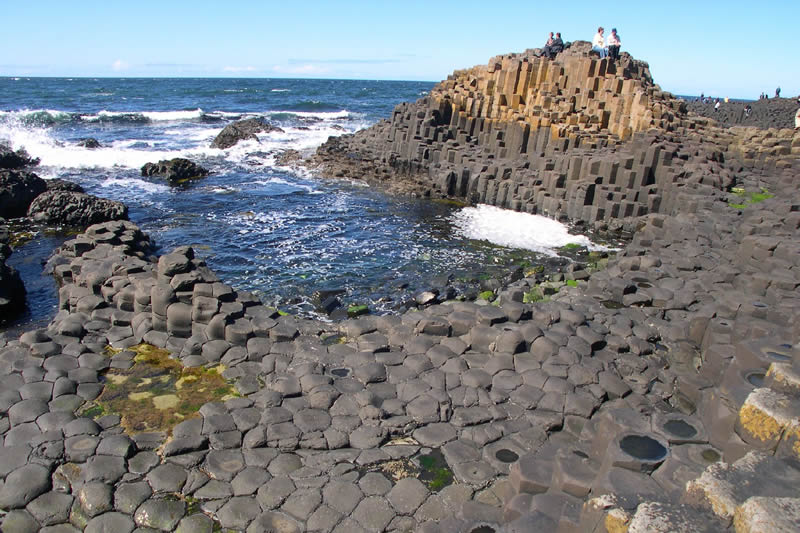
The Old English poem, The Seafarer, describes immense stone walls that were the workmanship of giants. The Giant’s Causeway in Nothern Ireland – natural geologic formations consisting of massive basalt columns – was claimed to have been the work of giants.
The Kai of New Guinea recall a race of demigods or giants called the Ne-Mu. They were said to be taller and stronger than the mortal race of today, but they were lords of the Earth before the Great Flood. They taught the Kai ancestors the fundamentals of agriculture and house construction. The Ne-Mu were wiped out during the Deluge, but their bodies transformed into blocks of stone. “This final feature of the myth,” Frank Joseph writes, “betrays the Kai’s reaction to megalithic structures found occasionally in New Guinea, often composed of prodigious stonework they identify with the pre-Flood Ne-Mu.” (Joseph, 2005)
The natives of the Fijian islands believe that their ancestral land, called Burotu, sank long ago into the Pacific Ocean. This ancestral realm was obliterated when the “heavens fell down”, and fire and water melded together to produce the islands of Samoa. The survivors, known as the Hiti, were thought to be a race of giants, the children of Atlantis. They built a monumental arch standing almost 20 feet [~6.1 metres] high.
Arabic myth describes a race of giants known as the Adites. These beings are the equivalent of the Atlantean Titans of Greek mythology, and are described as superior architects and builders. Since their earliest recorded history, Arabs in the Middle East have associated all immense structures with these great giants of antiquity.
Bochica is a figure in the myths of the Chibcha peoples of what is present-day Colombia. A bearded, white-skinned giant similar to Atlas, he supports the sky on his shoulders. When the people forsake his teachings, he eventually drops the sky, causing a series of floods and conflagrations that decimate the planet. This event also destroys the giant’s own home, forcing his children to flee and seek shelter elsewhere. In the end, they settle along the coast of Colombia, eventually becoming the country’s native Indian inhabitants.
As you can see from this small sampling (see Joseph, 2005), the sheer number and variety of myths and legends about giants are fairly staggering. Indeed, these myths and legends can be found in almost every culture on Earth. Many of these mythologies include beings closely related to the Titans, who supposedly once ruled Atlantis. And of course, there is also the recurring narrative of a great cataclysm that eventually destroys a civilisation at some time in the remote past. Such common themes and motifs set a precedent for an even broader discussion.
The Triple City of the Vishnu Purana is clearly emblematic of the trident of Poseidon, the patron god of Atlantis. In a final war, both the Daityas and Tripura are destroyed – yet another similarity to the myth of Atlantis. (Joseph, 2005)
In addition to the Daityas, another race of Hindu giants worth mentioning are the Rakshas, if only for their gruesome and diabolical reputations. According to the Ramayana, these giants were born from Brahma’s foot. Other myths trace their bloodline to the demon Pulastya, or other such devils as Khasa, Nirriti or Nirrita.
Hindy belief maintains that the Rakshas in previous incarnations, their current reincarnation as one of these hideous giants being punishment for past sins. The Rakshas were unequalled in their ferocity. They interrupted sacrifices, desecrated burial sites, harassed priests, took possession of impressionable young humans and committed numerous other crimes.
The Rakshas are described as mean, vicious creatures, villainous and cruel, exceedingly ugly, gigantic in stature and as black as soot. They have two fangs protruding out of their mouth like a vampire, and have sharp nail-like claws. They are often depicted prowling through the night like wandering beasts. Due to their obvious connection to the mythology of vampires, Rakshas have also been associated with the undead. Further emphasising their venomous, beast-like persona, they were also depicted as being cannibals. Descriptions such as these are consistent with ancient fold-customs and Hindu lore.
In the great epics, the Ramayana and the Mahabharata, the Rakshas have greater significance. The rakshas are described as a populous race of the supernatural humanoid giants. Some Rakshas follow the path of righteousness; others have simply degenerated into evil. They have proven themselves in battle as supreme lords of war, and they are also gifted magic-users in addition to being skilled shape-shifters. They are known to gulp down the blood-drenched legs and torsos of fallen soldiers on the battlefield, and thus are employed as rank-and-file combat soldiers to keep them from obtaining any true prominence, but sometimes a Raksha will attain distinction and be considered a hero. (Joesph, 2005)
The Greek saga the Argonautica describes the giants in the following manner: “Their bodies have three pairs of nerved hands, like paws. The first pair hangs from their gnarled shoulders, the second and third pairs nestle up against their misbegotten hips…” (Quoted in von Daniken, 2010.)
The earliest known Greek deities, the Titans, ruled the primordial universe before the coming of the Olympians. This myth parallels that of the biblical Nephilim, who ruled the Earth until their age ended and gave way to the rise of mankind. Atlas, perhaps the most well-known of the Titans, was the ruler of Atlantis and, as Frank Joesph notes in The Atlantis Encyclopedia (2005), was the founder of astrology and astronomy.
Atlas is often depicted in illustrations as a gigantic, bearded man crouching on one knee and bearing the sphere of the heavens upon his massive shoulders.
Such imagery has come to signify the Atlanteans’ stalwart dedication to celestial and planetary sciences. Perhaps not surprisingly, the Sanskrit word atl means “to support or uphold”. (Joesph, 2005)
Interestingly enough, Atlas is also the name of a mountain in Asia Minor not far from the incredible ruins of Catal Huyuk, perhaps the oldest city on Earth.
It is more than 9,000 years old and dates back to the destruction of Atlantis, possible even to the very first colony of its fleeting survivors. (Joesph, 2005)
Gigantomachy, the battle between the giants and their main opponents, the Olympian gods, is perhaps the most widely known depicted struggle in Greek art and literary tradition. The giants bombard the gods with boulders and the flaming trunks of burning trees. According to the oracle, the gods themselves will be unable to destroy the giants unless a powerful mortal aids them. Of course, in ancient Greece this could be only one individual: the legendary Heracles. (Sacks, 1995, p. 92)
The Gigantes are not the only large beings in Greek mythology. The gods themselves are also giants. Unlike the Gigantes, however, these gods are blond-haired, fair-skinned and distinctly Nordic in appearance.
This is consistent with the fact that Caucasians (sone of whom were depicted as giants in contemporaneous reports) were once dominat and prevalent in areas long thought to be the sole domain of non-European peoples. (ibid)
The Gigantes of Ancient Greek Mythology
Norse and Germanic Deities and Giants
Take, for example, the striking similarities between the Norse god Odin and Olle, the tribal god of North America’s Tuleyone Indians. Like Odin, Olle is a colossal giant with a horned helmet who is both a god of war and a saviour. Olle rescues his people from a firey demon named Sahte. (Joesph, 2005)
The Norse god Thor is, of course, one of mythology’s greatest warriors against the enemies of humanity – the dwarves, dragons, monsters and yes, other giants. The German scholar Herbert Kuhn has traced Thor to perhaps the darkest chapter in human history, the Old Stone Age, when hunter-gatherers living in caves dominated northern Europe. Thor’s weapon of choice was the hammer, which, according to Kuhn, means “stone” and is the basis for a new theory liking the Iron Age god Thor to the Stone Age. In Sanskrit, he is called Tanayitnu, or “the Thunderer”. (von Daniken, 1969)
The sagas tell us of the earliest beliefs and cosmologies of the ancient Norse and Germanic peoples of northwestern Europe. We had visions of the frost giants of Jotnar. Accorfing to the Eddas, one of the ancient collections of Norse stories, there are two races of giants: the children of Thrud, who descend from the frost giant Ymir; and the children of Bor, who include the Aesir. Though tremendous in size, the Aesir are distinctly Nordic in appearance.
For reasons unknown, the giants battle in a protracted, seemingly interminable conflict. Finally, Odin, Vili and Ve, the first Aesir, ambush Ymir and murder him. When they slit his throat, in yet another allusion to the Great Flood, a great deluge of blood rushes forth and drowns most of the giants.
Some escape in a boat to a new realm called Jotunheim. The world as we know it, Midgard, is formed from the body of Ymir. His salty, watery blood becomes the oceans, rivers and lakes, his flesh becomes the earth, his bones the rocks and mountains, his hair the forests, and the maggots from inside his stomach the dwarves.
But it was the later descriptions of Aryan warriors and battles between giants that became most deeply engrained in the sensibilities of these western cultures and which actually had some foundation in reality.
Blavatsky’s Lemurian Giants
The Theosophical movement was Blavatsky’s own concoction of Far Eastern mysticism and esoteric knowledge. It combined Judaeo-Christian tradition with crude Social Darwinism. Blabatsky became one of the most controversial figures of the last century, and has been viewed as forerunner of the Nazi movement due to her introduction of the myth of the Aryan as the superior fifth root race of humankind. It might be noted that the Aryans are also depicted as being a race of light-skinned giants from the lost continent of Atlantis.
According to Blavatsky, “the giant Lemurians stood some 10 to 15 feet [~3.1 to 4.6 metres] tall, had skins resembling alligator hide, faces with protuberant mandibles, small eyes on the sides of their skulls and elongated, double-jointed limbs”. Scott Corrales explains: “By her description, Mu was a far cry from the halcyon Atlantis: it was a barren land covered in the emanations of active volcanoes, which caused its colossal inhabitants to live in crude huts made of hardened lava. But Madame Blavatsky improved her creations’ loss considerably by adding that with the passing of eons, these towering monsters evolved into the ancestors of the Australian aborigines and other Melanesian peoples.” (ibid.)
Chinese Mythology: The Story of the Giant Pangu
Like the Nordic and Celtic myths, it was a giant who was the first living being in Chinese mythology. In the beginning, the entire cosmos encapsulated by a single egg. Within this egg was a state of utter chaos. The boundaries that distinguish Heaven and Earth did not yet exist, and utter darkness reigned as there was no Sun or Moon nor stars. From this internal chaotic matter, the first being – the giant Pangu – emerged. Finding himself trapped in perpetual darkness and chaos, Pangu decided to bring order to chaos and create the known universe. His first act as creator of this new cosmos was to break through the egg that surrounded him. “The lighter part of the egg (yang) rose and became the heavens, while the heavier part (yin) fell and became the earth.” (Rosenberg, 1986, p. 360) Pangu stood upon the Earth for 18,000 years, preventing the sky from crashing to the Earth by bracing it with his forehead. Eventually Pangu laid down and fell asleep, during which time he died.
According to mythologist Donna Rosenberg: “Pangu’s head and his eyebrows formed the planets and stars. His left eye formed the sun and his right eye the moon. His flesh formed the soil of the earth and his blood the oceans and rivers. His teeth and his bones formed rocks, minerals, and gems. His breath formed the clouds and the wind, while his voice became lightning and thunder. His perspiration formed rain and the dew. The hair on his body formed trees, plants, and flowers, while parasites living on his skin became animals fish.” (ibid.)
The similarity to the death and dismemberment of Ymir and the subsequent creation of the world out of his body in Norse mythology is quite apparent. Indeed, even the part about the parasites on Pangu’s skin becoming animals and fish harkens back to German legend when the maggots inside Ymir’s stomach transformation into the race of dwarves.
Giants Who Travelled East
In their book Uriel’s Machine, Christopher Knight and Robert Lomas attempt to demonstrate that the so-called Watchers – a race of fallen angles who mated with mortal women and produced the giants who came to rule the antediluvian world-were in fact members of the Grooved Ware culture, so named after the grooved markings found on their surviving pottery. Some researchers theorise that this culture was also the progenitor of both the Celtic and Germanic peoples of western Europe.
In the Book of Enoch, the Watchers and their offspring implore Enoch to represent them: “All the giants [and monsters] grew afraid and called Mahway. He came to them and the giants pleaded with him and sent him to Enoch [to speak on their behalf].” (Quoted in Knight and Lomas, 1999, p. 302.) They then beg the god of Newgrange to spare them and the world from the comet about to strike and bring about the mighty deluge. The gods responds: “All the mystery had not yet been revealed to you…You have no peace…behold, destruction is coming, a great flood, and it will destroy all.” (ibid.).
Knight and Lomas believed that the Grooved Ware culture – the giants of biblical fame – knew of the coming catastrophe and felt that they would find safety and salvation only in the Tarim Basin, a high plateau guarded by the mountain ranges of Tibet and Mongolia. What they didn’t know, however, was that this mystery was about to be unravelled.
A series of Chinese archaeological excavations in the late 1980s revealed hundreds of mummies along the western border of China. These unique human remains exhibit clear Caucasian traits. Other ancient corpses in Mongolia, Siberia and Central Asia were also discovered, displaying the same European characteristics. While a fair number of these mummies date back to at least 3500 BC, others have been determined to be even older, dating around 4000-5000 BC. In addition to having European features, they wore western-style clothing, including plaid twill and the world’s earliest known of pairs of pants. Later, carbon-14 dating provided perhaps the best estimate of the mummies’ original age, placing them at 3,500 years before the birth of the Han Chinese civilisation. Evidence suggests that they are related to an Indo-European-speaking group of Caucasians known as the Tocharians. (Baumer, p.28)
These prehistoric Chinese remains were unknown to much of the outside world until a security breach led to the announcement of the discoveries in 1994. When they heard about this, Knight and Lomas made an interesting argument. One of the taller mummies, known as Chechen Man (also called Ur-David), is about 6.5 feet [~2.0 metres] tall. Some of the mummies are even taller. To the Asians who first recorded their encounters with these yellow-haired barbarians, asserted Kight and Lomas, they truly must have seemed like giants. These Tarim mummies, with their large builds and above-average heights, may have contributed or given rise to some of the rumors of giants and strange, yellow-haired peoples. The authors did not, however, explain away ancient accounts of monstrous and imposing beings that possessed near-supernatural or even extra terrestrial strengths and abilities.
Giants in the New World
In even the earliest written accounts of almost every culture, there can be found descriptions of fierce, light-skinned peoples who were once the central force of a lost civlisation.
Science writer Terrence Aym describes the following series of events in a 2011 article dealing with the presence of giants in ancient America. He also describes some of the encounters between European explorers and various gigantic Caucasian aborigines in Central and South America.
The Paiute tribe of present-day Nevada tells of an ancient war that they waged against a primordial race of white, red-haired giants. The Paiute call these imposing Caucasians the Si-Te-Cah. This name refers to the tule, a fibrous plant that giants used to construct rafts. According to tribal lore, this race was already living in North America when the ancestors of the Paiute arrived 15,000 years ago.
The modern scientific dogmatism dismisses these reports as sheer fantasy, but there has to be more to the accounts than just a case of overactive imaginations.
The physical remains of giant-sized Caucasian peoples have been found on almost every continent. In the United States, hundreds of sites have been excavated, including those in Virginia, New York State, Michigan, Illinois, Tennessee, Arizona and Nevada. Hard scientific evidence supporting the Paiute account of a war with giant red-haired Caucasians first came to light in 1924 at Lovelock Cave in Nevada. During prehistoric times, a massive freshwater lake called Lake Lahontan covered the region. It was underneath this vast body of water that the original cavern was positioned, and it remained underwater until the lake eventually dried up over time. According to the Paiute, the giants practised cannibalism, much in the same way the early Neanderthals did. Indeed, Neanderthal campsite remains include human bones with artificial cut-marks on them. The Paiute claim that the giants were as tall as 12 feet [~3.6 metres] in height, but these may have been exaggerations of a naturally tall Caucasoid race corresponding to the Nordic height.
According to myth, the Paiute pursued the giants into a cave. There, the giants took sanctuary and continued to resist the tribe, ignoring their demands to exit the cave and face the tribe head-on. The enraged tribesmen covered the cave with bush and then ignited it into flames. It was at this moment that they hoped they could force the giants out of the cave. A small number of the stalwart giants ran out of the cave entrance and were immediately pummeled by a barrage of arrows. Those who remained in the cave were overcome by intense fumes and perished.
In 1911, skeletons and fossils were found in the area dating to the time of the legend’s origin. Over 10,000 artefacts were unearthed, including the mummified remains of two red-haired giants. One of them was female, 6.5 feet tall, and the other a male that towered over 8.0 feet [~2.4 meters]. These relics proved once and for all that the Paiute myth of a war against a race of white, red-haired giants was not fantasy but was in fact stark reality. Evidence in the form of broken arrows that had been shot into the cave and a dark layer of burned materials confirms the description of the climactic battle scenes that conclude the legend.
Two very large skeletons were then unearthed in the Humboldt dry lake-bed near Lovelock, Nevada. Among the human remains was one skeleton – wrapped in a gum-covered cloth not unlike those found in Egyptian mummifications – which measured some 8.5 feet [~2.6 metres] tall. The other was an astounding 10 feet [~3.0 metres] tall.
The Book of Mormon, which also speaks of giants, calls these original inhabitants the Jaredites, often considered to be the Olmecs of Central America, but it is more than likely that the Olmecs were just a single part of a much more widely distributed population. In Ether 15:26, the Mormon scriptures claim that they were “large and mighty men as to the strength of men.”
The 16th-century chronicler Fernanfo de Alva Ixtlilxochitl wrote: “In this land called New Spain there were giants, as demonstrated by their bones that have been discovered in many areas. The ancient Toltec record-keepers referred to the giants as Quinametzin; and as they had a record of the history of the Quinametzin, they learned that they had many wars and dissensions among themselves in this land that is now called New Spain. They were destroyed, and their civilization came to and end as a result of great calamities and as a punishment from the heavens for grave sins that they had committed.” (Allen, p. 124)
It should now be clear that a real race of red-haired giants dominated the Americas at one time, perhaps tens of thousands of years before the arrival of the ancestors of today’s Native Americans across the Bering Strait some 13,000-15,000 years ago. In defense of this statement, one must concede that race is a mutable thing and that the physical appearance of New World humans during the Ice Age may have been quite different; perhaps they were part of a line that left no known descendants. By the same token, the presence of a forgotten Caucasian population in Asia that could have walked across Beringia with the other Asiatic is also a possibility. This would best explain some of the unusual results from recent genetic testing, which has actually confirmed the presence of Caucasoid genes in some of the existing ancient remains.
Western European explorers such as Ferdinand Magellan, Sir Francis Drake, Hernando do Soto and Commodore John Byron (grandfather of the famous poet Lord Byron) all reported encountering living giants in the Americas, remnants of a once proud and noble race of Caucasian “supermen”. A well-documented sighting by Magellan occurred in 1520 near Puerto San Julian, Patagonia. There, Magellan and his crew came upon a red-haired giant that stood nearly 10 feet tall and was described as having a “voice like a bull”. Later, Magellan learned from normal-sized natives that the giant belonged to a neighbouring tribe. “Remarkably,” Aym writes, “Magellan’s logs show that he and his crew captured two of these living giants and brought them aboard his ship intending to bring them back to Europe. Unfortunately the giants grew ill and they both died during the return of the voyage. Magellan had their remains buried at sea.” (Aym, 2009)
Conclusion
Even though the extent of human memory fails to penetrate the true mysteries of our remote past, mythology helps us reinforce who we are as a species and ultimately what happened to us in prehistory. The many myths of giants, gods and other advanced beings whose power supposedly once ruled this planet remain today the strongest non-archaeological evidence we have to support the race-of-giants hypothesis.
Myths are more than untrue accounts concocted by primitives, much more than metaphors or stories bearing symbolic or religious significance.
They are what remains of our history before the great age of the cataclysms which destroyed the global civilisation and changed humanity and this planet for another eight millennia.
Now, for the first time, the truth about giants are our past is finally coming to light.
About the Author:
F.K. Strerling is a writer, freelance journalist and former producer of Archeology TV. Now the publisher and editor-in-chief of The New Archaeology Review, he lives in Florida, USA.
He is the author of Forgotten Worlds (Bear & Company, 2012; reviewed in NEXUS 19/06).
His article “Dragons in Myth and Recorded History” was published in NEXUS 19/06.
EUREKA LORE MAGAZINE
EUREKA LORE MAGAZINE caters to those with a discerning eye for intriguing stories and a passion for exploring the depths of legend and lore. Delve into the pages of this publication to immerse yourself in the rich tapestry of tales and information that celebrates the unique culture and heritage of Eureka Springs, offering a truly enriching reading experience for all.
Mailing Address
PO Box 13
Eureka Springs Arkansas 72632