Why Stones, Bones and Forgotten Voyagers Gets Ancient America Right
My new book argues that the Americas were never isolated, never young, and never alone, and that the key to the whole mystery lies in the ancient hills of the Ozark Plateau. The evidence is on my side.
By F.K. Sterling
For more than a century, American schoolchildren have been taught a story about their continent’s past that is simple, tidy, and, it is becoming increasingly clear, wrong. In that story, a single band of hunters walked across a land bridge from Siberia about thirteen thousand years ago. Their descendants spread south, invented everything they would ever know in total isolation from the rest of humanity, and waited, cut off from the world, until three Spanish ships sighted an island in the Bahamas in 1492.
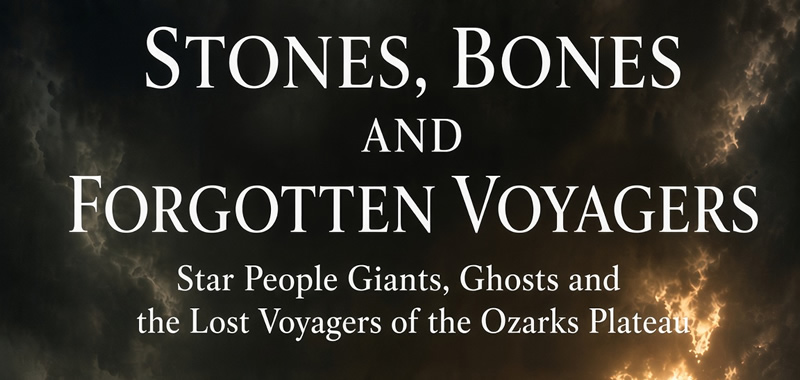
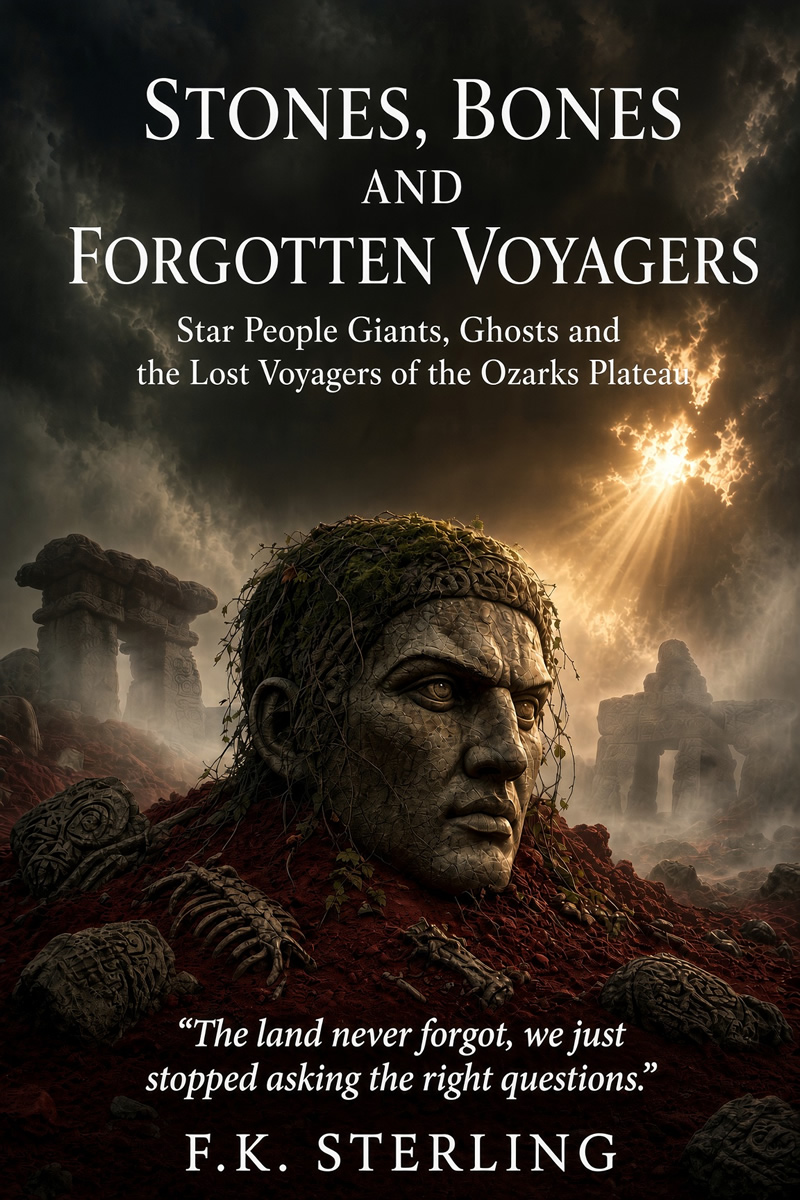
F. K. Sterling’s Stones, Bones and Forgotten Voyagers: Giants, Ghosts, and Forgotten Civilizations of the Ozark Plateau (Ozark Lore Books, 2026) takes that story apart piece by piece. What it builds in its place is bolder, stranger, and, on the evidence Sterling assembles, far more convincing: an ancient America that was deeply connected to the wider world, far older than the textbooks admit, and shaped by a lost civilization whose heart, Sterling argues, lay not beneath the Atlantic but high above the floodwaters, on the oldest ground in the heart of the continent.
He calls it Ozark Atlantis. After reading the book, it is hard to see the ancient Americas any other way.
A Book in the Great Tradition
Sterling writes in a tradition that readers of this magazine know well. His Author’s Note places the book squarely alongside Graham Hancock’s Fingerprints of the Gods and America Before, Hugh Newman’s megalithic expeditions, Barry Fell’s America B.C., and Frank Joseph’s lost kingdoms of the heartland. It is, in Sterling’s words, “a journey,” an invitation to walk the ground where the official story runs thin and to ask what is actually there.
But what sets this book apart from much of the alternative literature is the way it marries that tradition to the hardest science we have.
Sterling, who studied anthropology and art history at Arizona State University before turning to independent research and writing, has clearly read the genetic literature closely. He does not wave away the geneticists. He uses them. And the result is a case in which the mainstream’s own data become the strongest witnesses for the alternative view.
The Ghost in the Genome
The book’s argument begins where the textbooks end: with a child’s grave in Siberia.
Around 24,000 years ago, at a place called Mal’ta near Lake Baikal, a small boy was buried with ivory beads and a bird pendant. In 2014, a team led by Maanasa Raghavan in Eske Willerslev’s Copenhagen laboratory published his genome in Nature. The result stunned the field. The boy did not belong to the population ancestral to modern East Asians. He belonged to a vanished people that geneticists now call the Ancient North Eurasians, and their DNA turns up in two places: in Europeans, who carry up to a fifth of their ancestry from this ghost population, and in every Indigenous people of the Americas, whose deepest ancestry traces roughly one-third back to it.
Sterling’s point is simple and devastating. The idea that alternative researchers have been ridiculed for proposing, a deep and ancient link between the Old World and the New, is written in the genome. It is published, peer-reviewed, and replicated. As he puts it: “This is not a fringe theory. What is fringe, apparently, is asking what it means.”
He goes further. In a chapter titled “Reading Reich,” Sterling examines the work of Harvard geneticist David Reich, whose laboratory has sequenced a large share of the world’s ancient genomes. Reich and his colleague Nick Patterson predicted the Ancient North Eurasians from the DNA of living people before a single bone had been found, calling them a “ghost population.” Sterling argues that Reich’s ghosts are, in effect, a scientific admission that the human record is full of lost peoples who shaped history and then vanished, precisely the kind of lost chapter that Graham Hancock has been describing for thirty years.
And then there is the finding Sterling calls “the buried headline.” In 2015, Reich’s own laboratory, with Pontus Skoglund as lead author, reported in Nature that certain peoples of the Brazilian Amazon carry a faint genetic affinity with the Indigenous peoples of Australia and New Guinea. The source was named “Population Y.” No one predicted it. No one has explained it. The ancestors of the first Australians were demonstrably capable of crossing open ocean more than fifty thousand years ago. As Sterling notes, the official story has no room for Pacific voyagers in the Ice Age. “The genome, apparently, does.”
Sterling’s reading of the genetics is one of the book’s great strengths, and his central insight here is one that every reader should take away: when a geneticist says there is “no evidence” of an ancient visitor, what he usually means is that there is no evidence in the samples that have been tested. The Americas are badly under-sampled. Many of the oldest skeletons have been reburied. A small group of voyagers or teachers who passed on knowledge but left few descendants would be almost invisible in the genome. Genetics reads bloodlines, not blueprints.
Older Than They Tell Us
The second pillar of Sterling’s case is time, and here the mainstream has been retreating for fifty years.
For half a century, American archaeology was ruled by the “Clovis First” doctrine, which held that no one reached the Americas before about 13,000 years ago. At the Page-Ladson site in Florida’s Aucilla River, James Dunbar and his colleagues found evidence of mastodon butchery that was finally confirmed in 2016 at 14,550 years old.
Then came White Sands. In 2021, a team led by Matthew Bennett published in Science the discovery of human footprints in an ancient New Mexico lakebed dating to between 21,000 and 23,000 years ago, at the height of the last Ice Age, dates confirmed again in 2023.
Sterling’s handling of this material is sharp. He shows that every decade the date gets older, every decade the establishment resists and then concedes, and every decade the window opens wider for exactly the possibilities alternative researchers have described all along. He applies the same logic to the monuments. At Watson Brake in Louisiana, earthen mounds were raised around 3500 BC, older than Stonehenge and the pyramids of Egypt. At Caral in Peru, a city of monumental pyramids was flourishing by 2600 BC, contemporary with Giza.
“In my view,” Sterling writes of Caral, “Caral looks far less like a beginning than like an inheritance.” It is a line in the best Hancock tradition, and the evidence supports it. Civilizations do not wake up one morning knowing how to plan a city, raise pyramids, and track the moon through its 18.6-year cycle. That knowledge came from somewhere.
The Sky in Stone
Nowhere is that question more pressing than in the astronomy of America’s great monuments, and Sterling’s chapters on Mystery Hill and the Ohio earthworks are among the finest in the book.
At the Newark Earthworks in Ohio, built by the Hopewell some two thousand years ago, the physicist Ray Hively and philosopher Robert Horn showed in the early 1980s that the great Octagon was aligned to the eight rising and setting points of the moon over its 18.6-year cycle. The builders had tracked the moon’s slow wobble across the horizon for generations, then moved millions of basket-loads of earth to capture it. At Mystery Hill, better known as America’s Stonehenge, in New Hampshire, standing stones mark the solstices and equinoxes in the same way the great monuments of the British Isles do.
Drawing on the work of Freddy Silva, Sterling makes a powerful argument that these sites are not isolated inventions but regional expressions of a worldwide sacred science: the same astronomical obsession, the same geometry, the same preference for unusual ground. Serpent Mound, the great earthen serpent in Adams County, Ohio, sits on the edge of a crater-like geological structure that geologists attribute to an ancient impact. Graham Hancock has argued that its design may be far older than the official dates. When Hancock sought to film there for his Netflix series Ancient Apocalypse, the Ohio History Connection refused, on the grounds, as he reported, that his views on the site’s remote past did not align with mainstream archaeology. Sterling’s comment is pointed and fair: “If the establishment were confident in its dates, it would have welcomed him.”
Proof of Contact
If Sterling’s case rested on inference alone, it would still be compelling. But the book’s chapter “Proof of Contact” shows that the central claim of the alternative tradition, that the oceans were crossed before Columbus, has already been proven.
In 1960, Helge and Anne Stine Ingstad found the remains of a Norse settlement at L’Anse aux Meadows in Newfoundland, vindicating the Icelandic sagas that scholars had dismissed as legend. In 2021, researchers used the signature of a solar storm preserved in tree rings to show that the Norse were cutting wood there in exactly the year 1021, 471 years before Columbus.
In 2020, a team led by Alexander Ioannidis published in Nature genetic proof that Native Americans and Polynesians met around the year 1200. People on several eastern Polynesian islands carry Native American ancestry most closely related to the Zenú people of Colombia. Thor Heyerdahl, mocked for decades as a romantic amateur for sailing the Kon-Tiki from Peru to Polynesia in 1947, had been right about the thing that mattered.
Behind these proven cases, Sterling assembles a formidable body of evidence that deserves far more attention than it has received: the Roman-style terracotta head excavated in 1933 from a pre-conquest burial at Tecaxic-Calixtlahuaca in Mexico; the Bat Creek Stone, which the great Semitic scholar Cyrus Gordon read as ancient Hebrew; Gloria Farley’s decades of work documenting the Heavener Runestone and other inscriptions along the Arkansas River; and Scott Wolter’s forensic analysis of the weathering on the Kensington Runestone.
The pattern, as Sterling shows, is unmistakable. A generation ago, every item on this list, including the Norse and Polynesian voyages, was dismissed as fantasy. Two are now in the textbooks. The only question is which will be next. As Sterling puts it: “Each time a case of contact has been definitively tested, the voyagers have won.”
The Bones That Do Not Fit
Sterling’s section on “Forbidden Bones” is where the book’s alternative voice rings loudest, and it is also where its argument is most original.
He reminds readers that many of the oldest human remains in the Americas, from Kennewick Man in Washington to the long-headed people buried at Windover Pond in Florida to the young woman known as Luzia in Brazil, have skulls that look strikingly different from those of later Native Americans. When their genomes were sequenced, they proved to be ancestral to Native Americans. The mainstream treats that as the end of the conversation. Sterling treats it as the beginning.
“Kennewick Man’s skull said Pacific,” he writes. “His genes said Native American. When two instruments disagree, the scientist’s job is not to throw one away. It is to ask what could make both true.” His answer, that the first Americans carried the imprint of a far older, far wider world, is exactly the kind of question the academy should be asking and is not.
He is equally persuasive on the giants. Drawing on Fritz Zimmerman’s Encyclopedia of Ancient Giants in North America, and the work of Jim Vieira, Hugh Newman, and Ross Hamilton, Sterling points to hundreds of nineteenth- and early twentieth-century reports of unusually large skeletons pulled from American mounds, many of them written in sober language by local physicians and antiquarians. The bones, for the most part, can no longer be produced. Sterling’s proposal is refreshingly practical: match the published reports against surviving museum collections, locate the remains that still exist, and measure them properly, with the involvement of the Native nations concerned. That this has never been done tells us more about institutional priorities than about the giants themselves.
Importantly, and to his great credit, Sterling explicitly rejects the old nineteenth-century “Mound Builder myth,” which pretended that Native Americans could not have built their own monuments and was used to justify taking their land. His argument is not that someone else built the wonders of ancient America. It is that the ancient Americas were part of a larger world.
Ozark Atlantis
All of these threads lead, in the book’s first and final sections, to Sterling’s own theory, and it is the book’s most exciting contribution.
Plato’s account of Atlantis, recorded around 360 BC, places the destruction of the lost island empire nine thousand years before the time of Solon, around 9600 BC. That date falls almost exactly at the end of the Younger Dryas, the sudden return to glacial cold that closed the last Ice Age amid rising seas and, according to a growing number of researchers, a cosmic impact. Across North America, the collapsing ice sheets released catastrophic floods. The meltwaters of the north poured down the Mississippi and its tributaries and spread across the vast lowlands of the Mississippi Embayment.
Rising directly west of that floodplain stands the Ozark Plateau.
Sterling’s insight is that the Atlantis tradition has always had two halves: the land that drowned, and the high ground where the survivors stood. The Ozarks are among the oldest ground in the interior of North America. At their core, the St. Francois Mountains of Missouri are built of volcanic rock roughly a billion and a half years old, and geologists describe them standing as islands above the shallow seas that covered the rest of the continent’s heartland hundreds of millions of years ago. The Ozarks have been a refuge above the waters for as long as the continent has existed. They are a land of thousands of caves, of great springs that never fail, and, together with the neighboring Ouachita Mountains, of some of the finest quartz crystal deposits on earth.
If you were a people living in the heart of North America as the Ice Age ended and the lowlands vanished beneath meltwater, Sterling asks, where would you go? The answer is obvious. Up.
The archaeology fits. At the eastern foot of the Ozarks, the Sloan site in Greene County, Arkansas, excavated by Dan Morse in 1974, is a Dalton-culture cemetery about 10,500 years old that the Arkansas Archeological Survey describes as one of the oldest, if not the oldest, documented cemeteries in the New World. Around the Ozark Plateau, like a ring, stand the great sites of the ancient heartland: Cahokia, the greatest city of ancient North America; Picture Cave in Missouri, whose walls are painted with the sky beings and birdmen of the Mississippian cosmos; the Toltec Mounds of Arkansas, laid out to the solstice and equinox sunsets using a standard unit of measure; and the Spiro Mounds at the Ozarks’ western edge, the “King Tut’s tomb” of the Arkansas Valley.
And the peoples who held the Ozarks remembered. The Osage, the Children of the Middle Waters, told that their ancestors came down from the stars into a world covered by water, until the Elk called on the four winds to drive the waters back and the land emerged. Their whole society was organized around the union of the Sky People and the Earth People.
Sterling reads that story not as a symbol but as a memory. It is the book’s boldest claim and its most beautiful one: that the founders of Ozark Atlantis were the Sky People of Osage tradition, the star beings remembered across Native North America, the Anunnaki of Sumer, and the “sons of God” of Genesis; that they chose the oldest high ground on the continent as their center; that their descendants survived the flood there; and that their knowledge flowed outward along the rivers to the builders of the great mounds and earthworks of ancient America.
Why It Matters
It would be easy to treat a theory this bold as mere speculation. But Sterling’s great achievement is to show that it explains more of the evidence, more simply, than the official story does.
It explains why the same astronomical knowledge appears in monuments across the continent: the knowledge had a common source. It explains why the mound-building tradition was already sophisticated five thousand years ago: it was an inheritance, not an invention. It explains why the oldest cemetery in the hemisphere lies at the foot of the Ozarks, why the great sites of the heartland ring the plateau, and why the peoples of the region remembered ancestors who came down from the stars onto a drowning world.
A Call to the High Ground
Perhaps the most important thing about Stones, Bones and Forgotten Voyagers is that it does not end with a theory. It ends with a call to action.
The Ozarks, Sterling reminds us, are one of the least-explored archaeological landscapes in the country. Of the thousands of caves on the plateau, only a small fraction have ever been surveyed. The elders who remember the stories of the “old people’s walls” and the “giant graves” are passing on. If the evidence of Ozark Atlantis is to be found, Sterling argues, it must be found soon.
And the tools to find it have never been more accessible. Ancient DNA can now be recovered from cave soil. Ground-penetrating radar can map buried earthworks without turning a spade. “The next great discovery in American prehistory may not come from a university,” Sterling writes. “It may come from a farmer with a drone, a diver with a camera, a hiker who notices a strange alignment of stones, or a reader of this book who goes out and looks.”
It is a fitting close to a book that honors the heretics who came before and carries their work into new territory. Sterling makes a compelling case that the cracks in the official story all lead to the same place: the ancient high ground of the Ozarks, where the Sky People came down, where the survivors stood above the flood, and where, if he is right, the story of the Americas truly begins.
As the book’s own epigraph puts it: The land never forgot. We just stopped asking the right questions.
Stones, Bones and Forgotten Voyagers: Giants, Ghosts, and Forgotten Civilizations of the Ozark Plateau, by F. K. Sterling, is published by Ozark Lore Books, Eureka Springs, Arkansas.
EUREKA LORE MAGAZINE
EUREKA LORE MAGAZINE caters to those with a discerning eye for intriguing stories and a passion for exploring the depths of legend and lore. Delve into the pages of this publication to immerse yourself in the rich tapestry of tales and information that celebrates the unique culture and heritage of Eureka Springs, offering a truly enriching reading experience for all.

Mailing Address
PO Box 13
Eureka Springs Arkansas 72632