F. K. Sterling's Case for an Archaic Relict Population in the Arkansas Highlands
A Book Built On A Timely Discovery
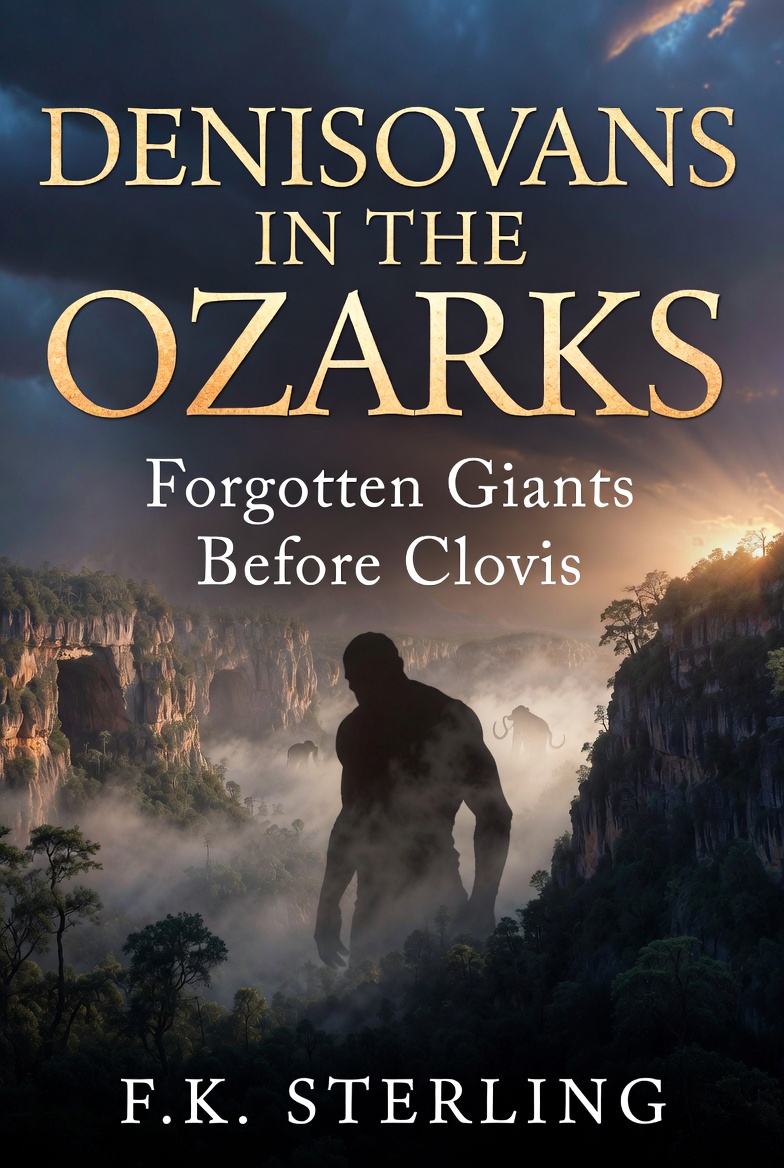
In the summer of 2025, a question that had stood open for fifteen years was answered. Since 2010, the Denisovans—an archaic human population first identified from a single finger bone in a Siberian cave—had been known almost entirely from DNA, a people without a face (Reich et al., 2010). That June, two studies led by Qiaomei Fu and Qiang Ji recovered ancient mitochondrial DNA from the dental calculus of the nearly complete “Dragon Man” cranium from Harbin, China, and, together with paleoproteomic analysis, identified the roughly 146,000-year-old skull as Denisovan—finally giving the population a face (Fu et al., 2025; Ji et al., 2021). It is against this backdrop that F. K. Sterling’s Denisovans in the Ozarks (2025) makes its argument, and the timing is not incidental. Sterling seizes on the new molecular portrait of a large, heavy-browed, big-toothed archaic human and asks a question mainstream paleoanthropology does not: could the “red-haired giants” of Ozark folklore and nineteenth-century bone reports be the trace of such a people, surviving late and far from Asia, in the sheltered highlands of northern Arkansas?
This article summarizes the book’s thesis and the lines of evidence it marshals, and situates its central claims against the genetic and archaeological record. The aim is neither to endorse nor to dismiss but to lay out clearly what Sterling argues, what genuine science he builds upon, and where his synthesis extends beyond—and in places against—the current scientific consensus.
The book itself is built as a cumulative case across twelve chapters, moving from the soft ground of testimony toward the hard ground of genetics and back again. It opens with Ozark folklore and local memory, proceeds through the physical geography of the proposed refuge and the region’s contested “giant” finds, arrives at its genetic centerpiece in the Denisovan and Dragon Man chapters, and closes with Native legend, mortuary ritual, decline, alleged suppression, and living descent. The structure is deliberate: Sterling wants the reader to feel the folklore and the geography before the DNA is introduced, so that the 2025 discovery lands not as an isolated fact but as the missing piece in a pattern the earlier chapters have already sketched. Whether that pattern is real or imposed is the question the book turns on, and it is worth taking each strand in turn.
The Genetic Backdrop The Book Builds Upon
Sterling’s argument rests on a foundation of real and now-well-established genetics, which the book cites accurately even as it draws unconventional conclusions from it. After the 2010 discovery of the Denisova finger bone, a high-coverage Denisovan genome was sequenced, allowing detailed comparison with Neanderthals and modern humans (Meyer et al., 2012; Prüfer et al., 2014). That work confirmed that Denisovans, like Neanderthals, interbred with anatomically modern humans, leaving a genetic legacy in living populations. Present-day people across Asia and, most strongly, in Melanesia and Aboriginal Australia carry Denisovan ancestry, and analyses of that ancestry point to more than one distinct pulse of admixture (Browning et al., 2018). Some of that inherited DNA is functional: the high-altitude adaptation of modern Tibetans, governed by the EPAS1 gene, is a Denisovan inheritance (Huerta-Sánchez et al., 2014), a textbook case of “adaptive introgression” (Racimo et al., 2015).
The 2025 identification of the Harbin skull is worth dwelling on, because it is both the book’s inspiration and, read carefully, a caution against the book’s conclusion. For fifteen years the Denisovans were a genome in search of a body; repeated attempts to pull DNA from the thick bone and teeth of the Harbin cranium had failed. The breakthrough came from an unlikely source—a scant fraction of a milligram of fossilized dental plaque, whose crystalline structure had sheltered enough authentic mitochondrial DNA to reconstruct a genome that matched known Denisovan sequences, corroborated by Denisovan-specific variants among the ancient proteins (Fu et al., 2025). It was a triumph of method as much as of luck, and it finally, in the words of one of the authors, gave the Denisovan a face. But it also underscored how thin the Denisovan fossil record still is—a handful of molars, two jaws, some bone shards, and now one magnificent skull—and how firmly every one of those specimens sits in Asia.
Crucially, the physical range of the Denisovans, as established by fossils and molecular evidence, is Asian: the Altai of Siberia, the Tibetan Plateau (the Xiahe mandible), Taiwan’s Penghu Channel, and now Harbin in China’s far northeast (Fu et al., 2025). The Denisovan ancestry found in living people descends from admixture events that took place in Asia and Oceania, not from any known population in the Americas. This distinction—between a genetic legacy carried into the New World inside the genomes of later migrants, and a distinct resident Denisovan population in the New World—is the fault line along which Sterling’s thesis diverges from established science, and it is worth holding in view throughout.
The Thesis, Stated Plainly
Sterling states his claim with unusual candor. “A small population carrying significant Denisovan genetic ancestry,” he writes, “reached the Ozark highlands of northern Arkansas at some point during the Late Pleistocene” (Sterling, 2025, Conclusion). The Buffalo River drainage, on this reading, offered precisely the conditions a small, archaic-admixed group would need to persist for millennia: stable fresh water, thermal refuge from glacial cold, extensive cave shelter, abundant food, and a geographic enclosure that preserved the isolation necessary to maintain a distinctive physical and cultural type. The “red-haired giants” that recur in Ozark folklore, in nineteenth-century newspaper reports of oversized skeletons, and—Sterling argues—in the oral traditions of the region’s Native peoples are, on his account, the memory and the material residue of this relict population making its long last stand in the Arkansas hills.
The book is careful, at least rhetorically, about the limits of its own case. Sterling concedes that the mechanism of arrival is unknown—whether an early pre-Clovis coastal migration (Dillehay et al., 2015; Erlandson et al., 2007) or a later stranding—and that the evidence is “neither simple nor complete” (Sterling, 2025). What follows in the book is an attempt to build a cumulative, circumstantial case from folklore, historical anecdote, regional geography, archaeology, and the new genetics, on the argument that no single strand proves the thesis but that together they point one direction.
The folkloric and historical evidence
The first and largest body of evidence Sterling assembles is testimonial and folkloric. He opens with the persistent Ozark tradition of “red-haired giants”—stories, as his chapter title has it, that “wouldn’t die” (Sterling, 2025, Ch. 1)—and with the recurring, oddly specific physical description attached to them: unusual stature, red or reddish hair, and, most striking, a double row of teeth (Ch. 4). He treats these accounts under the premise, defensible in folklore studies, that oral tradition can encode genuine historical and environmental memory across long spans of time (Dégh, 2001; Vansina, 1985), a premise supported by documented cases such as Aboriginal Australian traditions preserving memory of postglacial sea-level rise over seven millennia (Nunn & Reid, 2016).
He then turns to the historical record, cataloguing nineteenth- and early-twentieth-century reports—chiefly from local newspapers—of “documented giant finds” in Newton and Marion counties (Ch. 3), the classic Ozark bone-discovery accounts, alongside claims of oversized tools and giant handprints preserved in the region’s bluff shelters (Ch. 5). To this he adds Indigenous testimony, reading the Cherokee traditions of the Nunnehi and the giant Judaculla, and Osage legend, as regional memories of a red-haired giant people (Ch. 8; La Flesche, 1921; Mooney, 1900).
It must be said plainly that this is the softest part of the case. The double-row-of-teeth motif and red-haired-giant tales are a recurring feature of North American frontier folklore and of the wider “lost race of giants” literature, and the nineteenth-century “giant skeleton” newspaper items are a well-known genre of the period, frequently exaggerated, misidentified, or fabricated (Feder, 2010). Native legends of “little people,” giants, and immortals are rich and real, but reading them as literal ethnographic reports of an archaic hominin is an interpretive leap that most anthropologists would not make. The Cherokee Nunnehi, for instance, are traditionally spirit-people or immortals rather than a biological population, and the giant Judaculla is a mythic figure of the mountains; treating them as memories of Denisovans imports a modern hypothesis into stories that carried very different meanings for the people who told them (Mooney, 1900). Sterling presents the material as convergent memory—independent traditions preserving the same real people—while a skeptical reader will see instead a well-attested and cross-culturally common folklore tradition doing what folklore does, its apparent convergences the product of shared narrative motifs catalogued long ago in the standard indexes of world folklore (Thompson, 1955) rather than of a shared archaic ancestor.
The geography of a refuge
The book’s most genuinely interesting move is geographic, and here Sterling is on firmer conceptual ground even where the specific application is speculative. Chapters 2 and 5 develop the Buffalo River corridor as a refugium—the ecological concept of a sheltered enclave where a population can survive environmental change that eliminates it elsewhere. The Ozark Plateau is an ancient, deeply dissected karst landscape, riddled with caves and springs and buffered against climatic extremes, and it was indeed a biological refuge for numerous plant and animal species through the glacial cycles of the Late Quaternary (Delcourt & Delcourt, 1987; Rafferty, 1980). Sterling’s argument is that what served as a refuge for temperate forest communities could, in principle, serve as one for a small, isolated human group as well—an enclosure whose cave shelter, water, and food would sustain a relict population, and whose geographic isolation would preserve the genetic and morphological distinctiveness such a population would require (Excoffier & Ray, 2008; Prugnolle et al., 2005).
The logic of the refugium is sound; the question is whether there is any population to apply it to. The book cites the region’s real and significant archaeology—the Ozark bluff-dweller sites, whose distinctive preserved material culture is genuine (Wolverton & Lyman, 1998)—but the bluff dwellers were fully modern humans of the Archaic and later periods, not an archaic relict, and nothing in the excavated record indicates the presence of a Denisovan-admixed population. The refuge is real. The refugees are the book’s hypothesis.
The Denisovan link and the problem of morphology
Chapters 6 and 7 form the hinge of the book, where the folklore meets the genetics. Sterling argues that the physical type reported in the giant tradition—large body size, heavy build, a robust jaw and large teeth—matches what the Denisovans are now known to have looked like, as revealed by the Harbin cranium: a very large skull with thick brow ridges, a big braincase, wide face, and large teeth (Fu et al., 2025; Ji et al., 2021). The 2025 identification of Dragon Man as Denisovan is, for Sterling, the confirmation that gives the whole edifice a plausible biological anchor. If Denisovans were large, heavy-featured people, and if the Ozark tradition remembers large, heavy-featured people, then—on the book’s reasoning—the tradition may be remembering Denisovans.
This is the argument’s most vulnerable joint, and honesty requires naming why. First, morphological resemblance of this general kind—large, robust, heavy-browed—is shared broadly among Middle Pleistocene Homo and does not uniquely mark Denisovans; it certainly cannot be diagnosed from folklore. Second, and decisively, there is no fossil, genetic, or archaeological evidence of Denisovans, or of any archaic hominin, in the Americas. The Denisovan range established by actual specimens is Asian (Fu et al., 2025), and the peopling of the Americas—reconstructed from ancient and modern genomes, including the Clovis-era Anzick-1 genome from Montana—describes the arrival of anatomically modern humans of Northeast Asian ancestry in the terminal Pleistocene, with no signal of a resident archaic population (Meltzer, 2009; Moreno-Mayar et al., 2018; Rasmussen et al., 2014; Skoglund et al., 2015). The red hair the tradition insists upon, moreover, does not follow from Denisovan biology; the genetics of hair color in archaic humans is known only in fragments, and a red-haired variant was inferred for some Neanderthals, not Denisovans (Lalueza-Fox et al., 2007; Rees, 2003). The morphological “match,” in short, is suggestive to the author and unpersuasive to the record.
Ritual, last stand, cover-up, and living blood
The book’s final chapters extend the thesis into archaeology, decline, suppression, and legacy. Chapter 9 reads a pattern of east-facing burials in Ozark caves as a distinctive ritual signature of the giant population, invoking the real and cross-culturally documented significance of body orientation in mortuary practice (Binford, 1971; Nilsson, 2017; Parker Pearson, 1999). Chapter 10 casts the Ozarks as the giants’ final refuge, the place where an ancient people made its last stand before extinction or absorption. Chapter 11 advances the most familiar trope of alternative archaeology: that the finds were hidden or destroyed, their evidence suppressed by scientific institutions unwilling to disturb the accepted narrative. And Chapter 12 argues that the “blood remains”—that Denisovan-derived ancestry persists in living descendants, to be recovered by DNA.
Each of these deserves a fair word and a candid one. Mortuary orientation is a genuine and meaningful archaeological variable, but an east-facing burial is common worldwide and indexes nothing specifically archaic. The “suppression” chapter belongs to a long and well-analyzed tradition of claims that the Smithsonian and academic archaeology conspired to bury evidence of giants or a lost race—claims that historians of the discipline have examined at length and found to rest on misreadings, hoaxes, and the ordinary attrition of nineteenth-century collections rather than conspiracy (Feder, 2010; Thomas, 2000). And on living descendants: Denisovan ancestry is indeed present in living people and detectable by DNA, but in Asian and Oceanian populations, through ancient Asian admixture—not as the residue of an Ozark relict, and the distinction is not a technicality but the whole question.
Assessment
What, then, is Denisovans in the Ozarks? It is a serious and well-read work of alternative archaeology—far better sourced than the genre’s norm, drawing accurately on the real frontier of Denisovan science and framing its claims with genuine scholarly apparatus. Its central intuition, that a striking new fossil discovery might illuminate old regional folklore, is the kind of cross-pollination that keeps a subject alive, and its treatment of the Ozark refugium and of oral tradition as historical memory is thoughtful. Read as a synthesis of Ozark giant lore, gathered and organized and set beside the 2025 Dragon Man breakthrough, the book has real value as folklore, as regional history, and as a provocation.
Read as a scientific claim, however, its thesis is not supported by the physical, genetic, or archaeological evidence, and in its key steps it runs against the established record: Denisovans are an Asian population whose legacy reached the Americas only inside the genomes of later modern-human migrants, there is no material trace of an archaic relict in the Ozarks, and the folkloric and morphological “convergences” the book relies on are, on examination, the ordinary furniture of frontier legend and generic Pleistocene anatomy rather than diagnostic evidence (Feder, 2010; Meltzer, 2009; Moreno-Mayar et al., 2018). The paradigm the book invokes at its outset—Kuhn’s account of how anomalies overturn settled science (Kuhn, 1962)—cuts both ways: anomalies overturn paradigms only when the anomalies are real and measured, and here the anomalies are, so far, tales and old newspaper columns rather than bones and sequences.
It is worth being concrete about what would move the thesis from the conceivable to the compelling, because the book gestures at this without quite committing to it. The claim is, in principle, testable. Denisovan ancestry is detectable in genomes, and ancient DNA has been recovered from human remains far older and far more degraded than anything the Ozark thesis requires (Meyer et al., 2012; Rasmussen et al., 2014). A single well-provenanced set of skeletal remains from an Ozark bluff shelter or cave, securely dated and yielding either anomalous archaic morphology confirmed by measurement or a genome carrying a Denisovan signal beyond the small, Asian-derived fraction expected in any modern individual, would transform the argument overnight. No such remains have been produced. Until they are, the honest verdict is not that the thesis has been refuted—an absence of relict Denisovans is hard to prove absolutely—but that it rests on no positive physical evidence at all, and that everything currently on the table is explained more economically by folklore, misidentified nineteenth-century finds, and the ordinary human tendency to see a pattern once a vivid new fact suggests one.
Sterling’s book is best understood, in the end, as what its own honest Conclusion half-admits it is: an argument, offered on incomplete evidence, that asks its readers to entertain a possibility the data do not compel. That is a legitimate thing for a book to do, provided the reader is told the difference between the compelling and the merely conceivable. Denisovans in the Ozarks is a vivid, learned, and genuinely engaging tour of that possibility—and a useful reminder that the space between a real scientific discovery and the uses to which it can be put is exactly the space where a careful reader has to do the most work.
EUREKA LORE MAGAZINE
EUREKA LORE MAGAZINE caters to those with a discerning eye for intriguing stories and a passion for exploring the depths of legend and lore. Delve into the pages of this publication to immerse yourself in the rich tapestry of tales and information that celebrates the unique culture and heritage of Eureka Springs, offering a truly enriching reading experience for all.

Mailing Address
PO Box 13
Eureka Springs Arkansas 72632